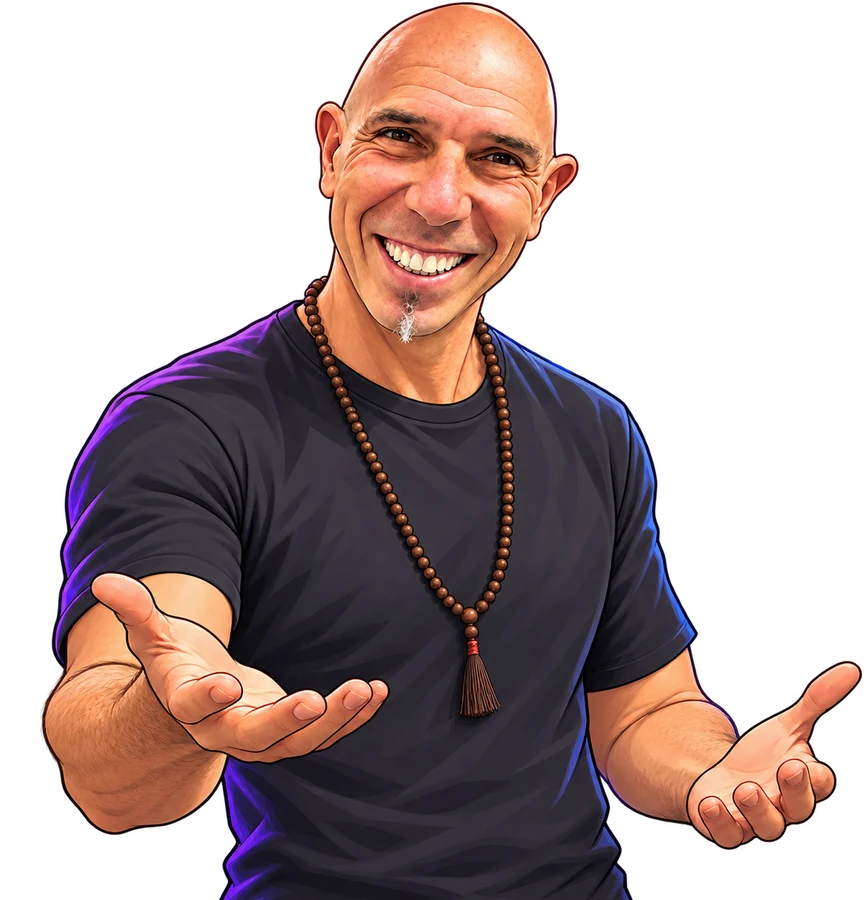
I'm not writing this page to impress you. I'm writing it so you know who is talking with you throughout the book, and why the book looks the way it does.
I was born in Chile, and I live in Israel. Over the years I've come to understand how crucial language is to our development, so the first thing I wanted to do with this book was to publish it in several languages. I also travel a lot around the world, on long trips and many treks. During one of my sabbatical years, a wild year, I was mostly in the East, and it was truly a gift of life.
I am a faculty member at the School of Education at Tel Aviv University, in the Department of Special Education and Educational Counseling. Most of my research there is about mindfulness, compassion and social-emotional learning: in children, in teachers, in students with attention and learning difficulties, and in the relationships between them. I have built questionnaires in this field. I teach seminars and courses such as "Brain, Consciousness and Education", "Cognition, Emotion, Brain and Learning", "Meditation: Theory, Practice and Research" and "Social-Emotional Learning and Mindfulness", as well as methodology courses. I have been teaching statistics for a great many years: I started as a teaching assistant in the Department of Psychology in the late 1980s, and later I also taught the courses Introduction to Statistics and Advanced Statistics there. Since then I have taught in many places. I studied psychology and statistics at the Hebrew University, and then did my master's and doctorate in psychobiology at Tel Aviv University. I researched the brain, among other things with MRI imaging. During my doctorate I also trained as a shiatsu therapist.
And the road was not only academic. I made earrings and sold them on a pedestrian street, I worked for many years as a waiter, and I was also a carpenter, with a workshop of my own.
And there is something else that is pretty typical of me: a bottle on my head. I walk with it, ride my bike with it, and dance with it, even at parties. More than once other people join in, and suddenly there are several bottles on several heads. Sometimes I bring it to class, too.

Over the years I have met many students who struggle, and I tried to understand what exactly was hard for them to grasp. Much of what you will find in this book was born from those conversations. A warm bond formed between me and my students, and it stays with me to this day: almost everywhere I go, even abroad, I run into former students.
But statistics is only part of me. I have practiced meditation since I was young, and later mindfulness as well, and that is where my research grew from. I am the chair of the Center for Compassionate and Mindful Education and responsible for the research there. Our goal is to make mindfulness and compassion accessible, in a way that helps us become aware of our values and act on them. I also head the academic forum of the Beit Cholmim association, which spreads the 16 Virtues program.
And there was another chapter in my life, a less expected one: for more than ten years I worked at high-tech companies, in data mining and algorithm development. There I learned how a product works, what makes an interface comfortable and clear, and what creativity looks like when you need to solve a real problem.
For a long time I felt these were separate worlds: numbers, the brain, mindfulness, education, products. In this book I tried to connect them. Statistics provides the tools. Understanding human abilities and the mechanisms of the brain helps me know where to put the emphasis, so that the ideas are truly understood. Mindfulness teaches us to pay attention and be more aware, including of the thoughts that pop into our heads, like "I don't get math" or "I'm not good at this." Part of the difficulty is inside our own heads, and I invite you to come to this book with an open mind. And my experience building products is the reason there are labs here to play with, and not only formulas.
My goal is not only that you learn how to calculate. In the end, I hope you come out of this book a little more critical of what you read and hear, and a little more aware, of yourselves too. And that you understand the meaning of chance, of randomness, not only in statistics but in life as well.
Statistics at the corner shop
You can apply statistics in life, really in everyday life. Say I went to the corner shop and got short-changed. My immediate conclusion: the shopkeeper stole from me. And interestingly, if I had gotten too much money back, I would think he simply made a mistake. Bad things stand out very strongly, and good things stand out very little.
Instead of reaching a conclusion so quickly, I can act like a statistician. Once is a coincidence. I'll go back to the shop, and I won't even build a story around it. If the change is short the second time too, I take note, but I don't conclude anything yet. After three times it is fair to say: it looks like something consistent is going on here. Now I have a hypothesis, and I test it the next time. Only if it happens a fourth time as well can I conclude something.
And even then it is worth asking what else could explain it. Maybe all three times were in the same week, a week when something hard happened to him, and he is simply making mistakes with the math. Not on purpose, and only for now.
This way our decisions become more critical and less personal. And it turns out that most of what happens to us is not against us.
Throughout the book you will now and then meet a short note from me that connects what we have learned to life. You don't need it for the exam. I hope you will need it after.
Nice to meet you, and let's begin.
Ricardo